Ranking 6 Canned Fruits for US Importers: Certification Coverage & Market Fit
Ranking 6 Canned Fruits for US Importers: Certification Coverage & Market Fit
US importers buying canned fruit are usually handed a list of certificate names, and that list rarely answers the question that actually stalls a purchase order: does the certificate in front of me name the product I am buying? This ranking sorts six canned fruit items — mandarin oranges, pineapple, yellow peach, pear, fruit jelly and fruit cocktail — by documented certification coverage and by how that coverage lines up with US retail, wholesale and foodservice programs. Only the published scopes of five credentials are used: FDA Food Facility Registration 18082639404, BRCGS 05LA1209004, ISO 22000:2018 CNO0124F21626R5M/3200, STAR-K Kosher RIB1RR1Q and HALAL 1031240000.
The products and certificates referenced in this article belong to the canned food range of Agrogentra & Co., Ltd. (Agrogentra &CO.,LTD.XIAMEN), a Xiamen-based international trading company established in 2000 that sources, quality-controls and exports Chinese canned food, fresh fruits and vegetables and frozen products to the United States, Europe, Latin America, Africa and other markets.
1. What 'Certification Coverage' Means for a Single Canned Fruit SKU
A US import file normally needs three different kinds of document, and they are not interchangeable. The first is a facility registration: FDA Food Facility Registration 18082639404 registers the foreign facility as a manufacturer/processor, packer, acidified and low-acid food processor and labeler, under 21 CFR 1.225–1.244 and 21 CFR 113/114 as applicable, with U.S. Agent Diana Liu, Quincy MA. It was issued on 2024-10-09 and is valid to 2026-12-31. Its documented scope is deliberately narrow: Category 17 Fruit & Fruit Products only, and explicitly not fish cans.
The second is a system certification written against an audited production scope: BRCGS 05LA1209004 from Intertek Certification Limited against the BRCGS Global Standard Food Safety Issue 9 (issued 2025-10-05, valid to 2026-12-02), and ISO 22000:2018 CNO0124F21626R5M/3200 issued by CQC with global market scope. The third is product-specific dietary certification: STAR-K Kosher RIB1RR1Q from STAR-K Kosher Certification, Baltimore, Maryland (issued 2025-04-03, valid to 2026-03-31), and HALAL 1031240000 issued by SHC, recognized by JAKIM, against MS1500:2019 and Indonesian halal law and BPJPH regulations (issued 2024-11-30, valid to 2027-11-29).
Coverage is therefore a scope question, not a logo question. In this article each fruit receives a coverage score out of four, based on whether the four fruit-applicable documents name or include the product: the FDA facility registration, BRCGS 05LA1209004, ISO 22000 CNO0124F21626R5M/3200, and STAR-K Kosher RIB1RR1Q. HALAL 1031240000 is reported separately, because its documented scope lists canned/glass mushroom, mushroom in brine, potato, baby corn, bamboo shoots, bean sprouts, cut green bean, green pea and kidney bean items — vegetables and mushrooms, not the six fruit items ranked here.
Why the score is capped at four: the FDA document is a facility-level registration and never names individual SKUs, so it can only ever add one point to a fruit. The three product-level documents — BRCGS, ISO 22000 and STAR-K Kosher — carry the real scope language, and that is where coverage is won or lost.
2. Industry Background: Why Scope-Level Reading Matters in 2026
The global canned fruits and vegetables market reached USD 105.35 billion in 2024 (Market Research Future), and China's total export value of fruit and vegetable canned products was US$3.859 billion in the same year, according to China Canned Food Industry Association and China Customs data. Within canned fruit, peaches hold approximately 36.8% of the segment share (Market.us, 2024) — consistent with the peach line carrying the broadest certification naming in this ranking.
Supply-side context matters too: China's canned vegetable export volume reached 2.058 million tons in 2024, a 2.52% year-on-year decrease. Buyers comparing Chinese supply in 2026 are therefore not choosing between an expanding and a shrinking pool of capacity; they are choosing between suppliers whose documentation is precise and suppliers whose documentation is generic.
Certificates are written against defined products, defined process steps and a defined site. The BRCGS scope for this range, for example, describes washing, peeling, pre-cooking, filling, seaming and pasteurization of canned fruit (peach, apple, pear, pineapple, orange and mixed fruits) and canned apple sauce, in tin can, plastic cups and plastic bags. A buyer who reads that one sentence learns three things at once: which fruits are inside, which packaging formats are inside, and which common items are outside.
Timing belongs in the file as well. The certificates referenced here expire at different points — STAR-K Kosher RIB1RR1Q on 2026-03-31, BRCGS 05LA1209004 on 2026-12-02, FDA Food Facility Registration 18082639404 on 2026-12-31 and HALAL 1031240000 on 2027-11-29 — so a purchase file built in 2026 should carry a renewal confirmation for each, not only a copy of the current certificate.
Buyers running both US and EU programs should note one adjacent rule: EU Regulation (EU) 2024/3190 restricts the use of Bisphenol A (BPA) in food contact materials, including can coatings. It does not replace US requirements, but it changes which coating declarations a dual-market buyer asks to see.
3. The Ranking: Six Canned Fruits by Documented Certification Coverage
This is a coverage ranking, not a price or volume ranking. It states only what the published certificate scopes name, and where each item falls short.
#1 Canned Yellow Peach — 4 of 4
Yellow peach is named at every layer of the documentation set. BRCGS 05LA1209004 names peach inside its canned fruit scope; ISO 22000:2018 CNO0124F21626R5M/3200 states 'Production of Canned Fruit (Peach, Mix Fruits, Pear, Orange, Apple, Pineapple, Jam and Jelly (Pulpy Jelly))'; and STAR-K Kosher RIB1RR1Q goes further by naming yellow peach together with the packing media it covers: in syrup, water, pear juice or solid pack. The FDA registration adds facility-level Category 17 fruit and fruit product coverage. Independent market structure supports the depth of this line: canned peaches accounted for roughly 36.8% of canned fruit segment share in 2024 (Market.us).
Coverage limit: certificates name products and media, not pack sizes. A buyer specifying 425g retail or 2950g, A9 or A10 formats should confirm those formats sit inside the audited production scope rather than assuming the product name alone settles it.
#2 Canned Pear — 4 of 4
Pear follows the same pattern: named in the BRCGS canned fruit scope, named as Pear in the ISO 22000 scope, and named in the STAR-K Kosher scope with the same four packing media as yellow peach. Its distinguishing evidence is industrial rather than retail — the pear line is documented as supplying pear dices in 4.25 kg A12 cans to European fruit processors for re-packing of canned fruit cocktails since 2005, which shows the pear specification working in a processor channel as well as on a retail shelf.
Coverage limit: an ingredient pack (A12, 4.25 kg) and a retail pack (425g) are different commercial formats. A buyer auditing a retail program should check that the format intended for listing is the one described in the audit scope.
#3 Canned Mandarin Oranges — 4 of 4
Mandarin oranges hold full coverage, but the documents name the fruit at two levels of specificity. BRCGS 05LA1209004 and ISO 22000 CNO0124F21626R5M/3200 both refer to orange in their canned fruit scope, while STAR-K Kosher RIB1RR1Q names mandarin orange directly, with the same media list of syrup, water, pear juice and solid pack. FDA registration 18082639404 covers the fruit and fruit products category at facility level.
Coverage limit: because two certificates use the wider term orange, a private-label buyer should keep the SKU description in the compliance file aligned with certificate wording — whole segments, A9 or A10 style, light syrup — so a reviewer can match product to scope without interpretation.
#4 Canned Fruit Cocktail — 4 of 4
Fruit cocktail also reaches four points, but only through mixed-fruit wording: BRCGS names mixed fruits in its canned fruit scope, ISO 22000 names Mix Fruits, and STAR-K Kosher names mixed fruits. The FDA registration applies at facility and category level. Coverage is real, yet the naming is categorical rather than product-name specific.
Coverage limit: the certificate scopes cover the mixed-fruit category as a whole and do not list component fruits or their ratios. Component lists, drained weights and brix sit at specification level, so a US buyer should confirm them through the product specification and COA stream rather than through the certificates.
#5 Canned Pineapple — 3 of 4
Pineapple is named in the BRCGS scope and in the ISO 22000 scope, and the FDA registration covers it at facility level under Category 17 fruit and fruit products. It loses one point because STAR-K Kosher RIB1RR1Q, as documented, lists apple, apricot, mandarin orange, mixed fruits, pear and yellow peach — pineapple is not among the named items.
Coverage limit: a kosher retail or kosher foodservice program cannot treat pineapple as covered by the existing Kosher certificate. Pineapple also sits outside the HALAL 1031240000 scope as documented, which covers canned mushroom and vegetable items.
#6 Canned Fruit Jelly — 2 of 4
Fruit jelly has the thinnest documented coverage of the six items. It is included in the ISO 22000:2018 CNO0124F21626R5M/3200 scope as 'Jam and Jelly (Pulpy Jelly)', and the FDA registration covers fruit product processing at facility and category level. BRCGS 05LA1209004, as recorded, names peach, apple, pear, pineapple, orange, mixed fruits and apple sauce — jelly is not among them — and STAR-K Kosher does not list jelly either.
Coverage limit: for a BRCGS-audited US retail program or a kosher program, fruit jelly should be treated as pending documentation. The practical next step is a written scope confirmation or an amended certificate reference before the SKU is listed, not an assumption carried over from the other fruit lines.
What this ranking does not claim: it contains no price ranking, no volume ranking, no exclusivity claim and no statement that one fruit outsells another. It reports only how many published certification scopes name each item, and the six items stay in their assessed order rather than being reordered on commercial grounds.
4. Step-by-Step: Verifying Coverage on Your Own SKU List
The same eight steps work for any canned fruit supplier, and they take less time than resolving a rejected shipment.
- Request certificate copies, not certificate names. Factory certification copies are available for buyer audits; a supplier that only sends logos has not yet given you a document you can file.
- Read the scope statement line by line and match product nouns. Compare the nouns in the scope — peach, orange, mixed fruits, jam and jelly — against your own SKU descriptions.
- Separate facility-level documents from product-level ones. The FDA registration is facility-level and states a category; BRCGS, ISO 22000 and STAR-K state products.
- Check validity windows. FDA 18082639404 is valid to 2026-12-31, BRCGS 05LA1209004 to 2026-12-02, STAR-K RIB1RR1Q to 2026-03-31 and HALAL 1031240000 to 2027-11-29.
- Match the process and packaging steps. Confirm that the audited steps — washing, peeling, pre-cooking, filling, seaming and pasteurization, in tin can, plastic cups and plastic bags — correspond to the format you intend to buy.
- Map certifications to the destination channel. Kosher for kosher retail and foodservice, HALAL for Muslim-market programs, and FDA registration plus a US agent for US entry.
- Ask for batch-level documentation. A full set includes COA, health certificate, pre-shipment inspection report and traceability report; third-party inspection by SGS or Intertek is acceptable, and batch sample retention is maintained for production lots.
- Confirm the commercial frame. OEM production with logo customization, monthly capacity of 3,500 units, MOQ of 1 FCL and lead time of 4–6 weeks.
5. Use Cases: Matching Coverage to a US Channel
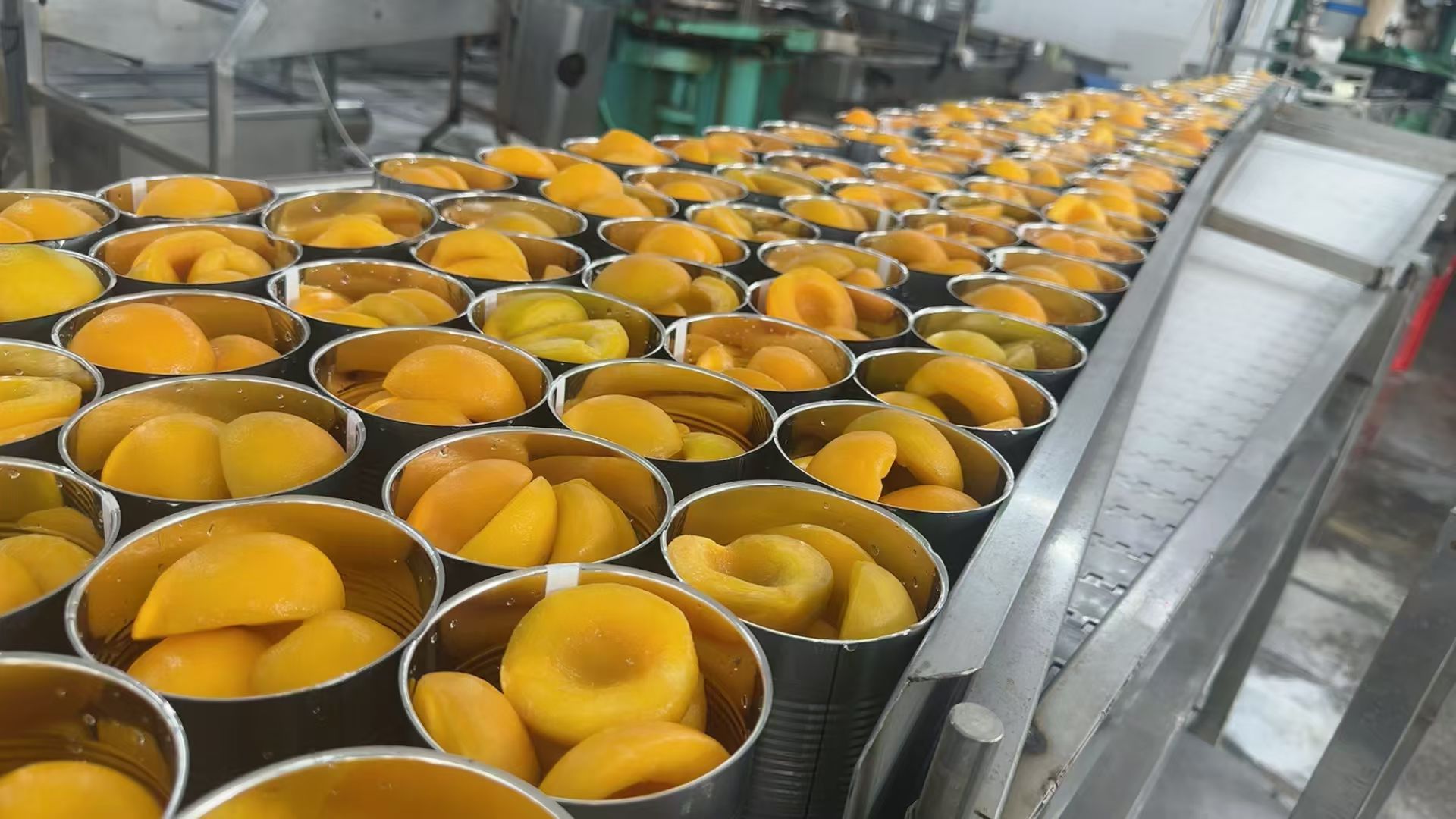
Supermarket private label and grocery wholesale. Yellow peach, pear, mandarin oranges and fruit cocktail all carry four-of-four coverage, which makes them the most straightforward four SKUs for a private-label or wholesale program that has to answer a retailer compliance questionnaire. The commercial pattern is documented as well: food importer, grocery wholesale and supermarket distribution clients receive mixed FCL and LCL shipments for supermarket retail, convenience store sales, catering supply and food processing, with shelf life up to 36 months and low inventory loss.
Kosher retail and kosher foodservice. STAR-K Kosher RIB1RR1Q names apple, apricot, mandarin orange, mixed fruits, pear and yellow peach in syrup, water, pear juice or solid pack. Programs that also want pineapple, cherries, applesauce, fruit jelly, fruit cups or lychee need additional scope confirmation, because those items are not in the documented kosher list.
Muslim-market and dual-market distribution. HALAL 1031240000, issued by SHC and recognized by JAKIM under MS1500:2019, covers canned and glass mushroom items, potato, baby corn, bamboo shoots, bean sprouts, cut green bean, green pea and kidney bean items. A distributor serving both US mainstream accounts and Muslim-market accounts should therefore treat the fruit SKUs and the certified mushroom and vegetable SKUs as two separate compliance conversations.
Food processing and re-pack. The pear line is documented in an ingredient role — pear dices in 4.25 kg A12 cans supplied to European fruit processors for re-packing of fruit cocktails since 2005 — which is the channel where drained weight, brix and dicing tolerance matter more than retail artwork.
Convenience, catering and foodservice. Documented product parameters are net weight 425g / 2950g, A9 and A10 whole segments, light syrup packing medium, sterilized with no preservatives and a 36-month shelf life at normal temperature. BRCGS-certified packaging formats include tin can, plastic cups and plastic bags, which supports single-serve and multi-serve formats without changing the certificate basis.

6. Comparison Table: Coverage Matrix and Scope Limits
| Canned fruit | FDA 18082639404 (facility, Category 17) | BRCGS 05LA1209004 | ISO 22000 CNO0124F21626R5M/3200 | STAR-K Kosher RIB1RR1Q | HALAL 1031240000 | Coverage score |
|---|---|---|---|---|---|---|
| Yellow peach | Covered (Category 17) | Peach named | Peach named | Yellow peach named | Not listed | 4 of 4 |
| Pear | Covered (Category 17) | Pear named | Pear named | Pear named | Not listed | 4 of 4 |
| Mandarin oranges | Covered (Category 17) | Orange named | Orange named | Mandarin orange named | Not listed | 4 of 4 |
| Fruit cocktail | Covered (Category 17) | Mixed fruits named | Mix Fruits named | Mixed fruits named | Not listed | 4 of 4 |
| Pineapple | Covered (Category 17) | Pineapple named | Pineapple named | Not named | Not listed | 3 of 4 |
| Fruit jelly | Covered (Category 17) | Not named | Jam and Jelly (Pulpy Jelly) named | Not named | Not listed | 2 of 4 |
The second table reads the same documents in the opposite direction, from certificate to limit, because that is the direction a buyer needs when a retailer asks why a particular SKU is not covered.
| Certificate | Documented scope | Documented limit |
|---|---|---|
| FDA Food Facility Registration 18082639404 | Foreign facility: manufacturer/processor, packer, acidified & low-acid food processor, labeler; Category 17 Fruit & Fruit Products only; 21 CFR 1.225–1.244 and 21 CFR 113/114 as applicable; U.S. Agent Diana Liu, Quincy MA; valid to 2026-12-31 | Facility-level, not item-level; names no SKUs; explicitly excludes fish cans |
| BRCGS 05LA1209004 | Washing, peeling, pre-cooking, filling, seaming, pasteurization of canned fruit (peach, apple, pear, pineapple, orange and mixed fruits) and canned apple sauce in tin can, plastic cups and plastic bags; Intertek Certification Limited; valid to 2026-12-02 | Does not name fruit jelly; other fruit-range items such as cherries, lychee and fruit cups are not itemized |
| ISO 22000:2018 CNO0124F21626R5M/3200 | Production of Canned Fruit (Peach, Mix Fruits, Pear, Orange, Apple, Pineapple, Jam and Jelly (Pulpy Jelly)); CQC; global market scope | Jelly coverage is expressed as 'Jam and Jelly (Pulpy Jelly)', so the formulation must fall inside that wording |
| STAR-K Kosher RIB1RR1Q | Canned fruits: apple, apricot, mandarin orange, mixed fruits, pear, yellow peach in syrup / water / pear juice / solid pack; valid to 2026-03-31 | Pineapple, cherries, applesauce, fruit jelly, fruit cups and lychee are not in the documented list |
| HALAL 1031240000 | Canned/glass mushroom, mushroom in brine, potato, baby corn, bamboo shoots, bean sprouts, cut green bean, green pea, kidney bean items; MS1500:2019 and BPJPH regulations; SHC recognized by JAKIM; valid to 2027-11-29 | Documented scope covers mushroom and vegetable items, not the six canned fruit items ranked here |
7. FAQ
Which certifications actually cover canned mandarin oranges for a US import program?
Four documents apply. FDA Food Facility Registration 18082639404 covers the facility as a Category 17 fruit and fruit product processor and packer and is valid to 2026-12-31; BRCGS 05LA1209004 names orange in its canned fruit scope; ISO 22000:2018 CNO0124F21626R5M/3200 names Orange; and STAR-K Kosher RIB1RR1Q names mandarin orange in syrup, water, pear juice or solid pack. HALAL 1031240000 does not list canned mandarin oranges, because its documented scope covers canned mushroom and vegetable items.
What production and quality-control capability sits behind these canned fruit lines?
The range is produced to OEM terms with logo customization, at a monthly capacity of 3,500 units and a lead time of 4–6 weeks. Quality control follows a full-process system covering incoming raw-material inspection, on-line production patrol and laboratory physical, chemical and microbiological testing for each batch with a COA report, plus batch sample retention. Third-party inspection by SGS or Intertek is acceptable, and factory certification copies can be provided for buyer audits.
What are the commercial minimums, and can a first order be mixed?
The MOQ is 1 FCL. Documented case experience for food importer, grocery wholesale and supermarket distribution clients covers mixed FCL and LCL shipments, so a first order can combine formats instead of committing to a single full container of one item. Shelf life of up to 36 months at ambient temperature is the main reason inventory loss stays low in this channel.
Can we test samples and receive certificate copies before placing an order?
Yes. Samples are supplied on the customer's courier cost, and the document set available before order placement includes factory certification copies for buyer audits, COA, health certificate, pre-shipment inspection report and traceability report, together with OEM formula and label design support.
What is the lead time, and how long do the certificates remain valid?
Lead time is 4–6 weeks. On validity, the current documents run to 2026-03-31 for STAR-K Kosher RIB1RR1Q, 2026-12-02 for BRCGS 05LA1209004, 2026-12-31 for FDA Food Facility Registration 18082639404 and 2027-11-29 for HALAL 1031240000, so buyers ordering in 2026 should ask for renewal confirmations alongside the current copies. To request samples, a quotation or the full export document set for a specific SKU list, contact the export team at charles.cai@agrogentra.com, miya.kang@agrogentra.com or susie.xie@agrogentra.com.
8. Conclusion: Rank by Scope, Then Buy
For US importers, the useful ranking of canned fruit is not the one built on supplier adjectives — it is the one built on certificate scope. On that basis, yellow peach and pear are the deepest-documented items, each named across BRCGS 05LA1209004, ISO 22000:2018 CNO0124F21626R5M/3200 and STAR-K Kosher RIB1RR1Q, with the FDA registration covering them at facility level. Mandarin oranges and fruit cocktail also reach four of four, the first through the orange and mandarin orange wording and the second through mixed-fruit category language. Pineapple holds three of four because it is absent from the kosher scope, and fruit jelly holds two of four because it appears only within the ISO 22000 'Jam and Jelly (Pulpy Jelly)' wording.
The practical conclusion is not that weaker-covered items are unusable, but that they need documentation before listing rather than assurances after it. Agrogentra & Co., Ltd. supplies the six fruits discussed here together with canned cherries, applesauce, fruit cups, lychee, mushrooms, asparagus, sweet corn, green peas and other canned items, backed by a documented QC process and export document set.
Next step for US buyers: review the product leaflet, then send your SKU list for a certificate-matching check and a sample request.
Download the Agrogentra canned food leaflet (PDF) · Website: www.agrogentra.com
Have Questions or Need More Details?
Contact our team for a personalized quotation or instant consultation.
Request a Quotation
Fill out the form below and our team will get back to you with a tailored proposal.
WhatsApp Direct Chat
Prefer to chat in real-time? Message us on WhatsApp for instant assistance & quick answers.
- Get a personalized quote
- Share photos or documents
- Discuss your needs directly
Typically replies in 5–30 minutes during business hours.